Two-Axis Gyro Stabilized Gimbals: Enhancing Surveillance Performance in Dynamic Environments
Introduction
In challenging environments such as offshore platforms, marine vessels, border surveillance systems, and mobile security applications, camera stability is critical for obtaining clear and usable video footage.
However, vibrations caused by waves, wind, vehicle movement, and mechanical equipment can significantly affect image quality.
This is where Two-Axis Gyro Stabilized Gimbals play an essential role.
By utilizing advanced gyroscopic stabilization technology, these systems compensate for unwanted motion and ensure smooth, stable imaging in even the harshest operating conditions.
What Is a Two-Axis Gyro Stabilized Gimbal?
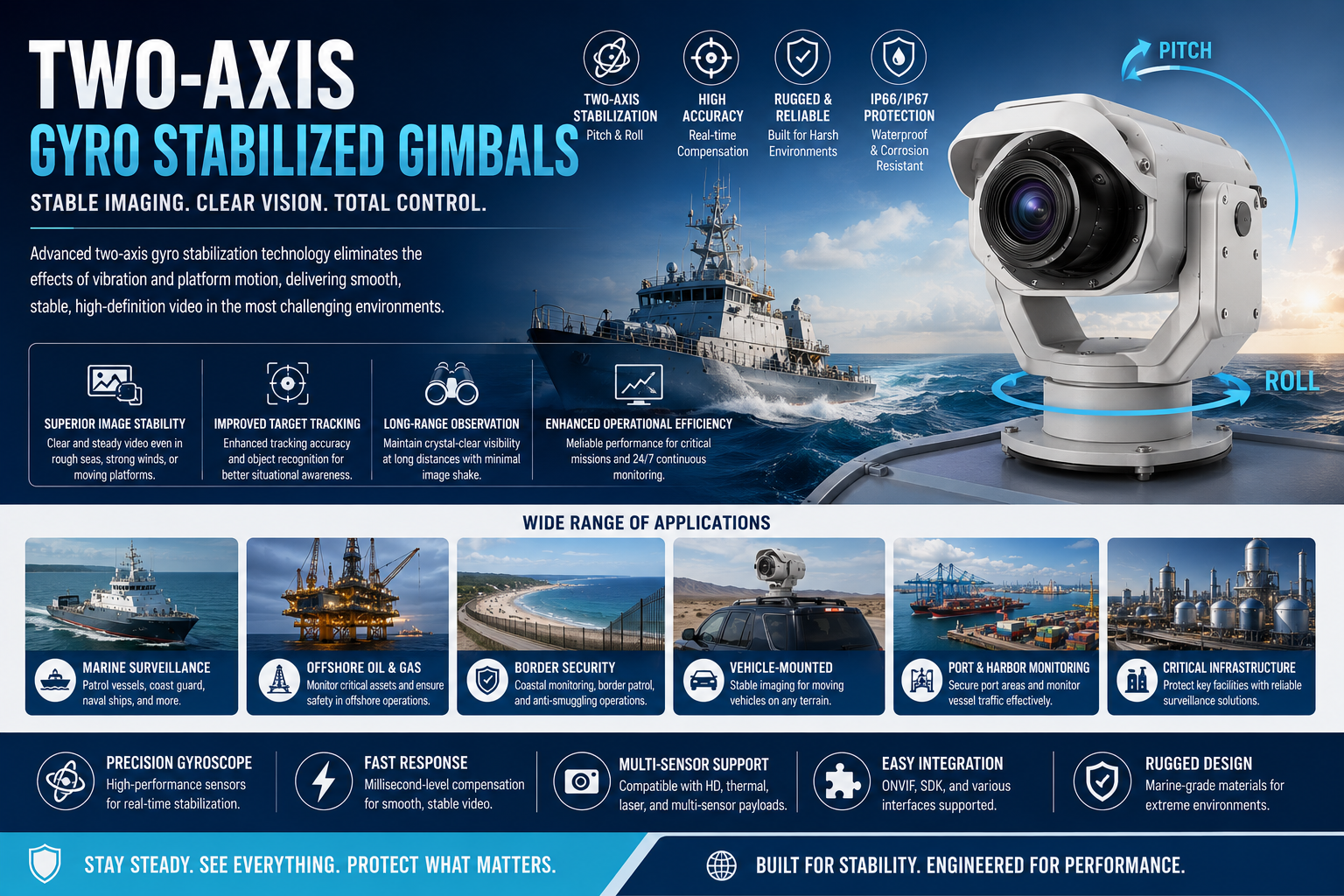
A Two-Axis Gyro Stabilized Gimbal is a precision stabilization platform that actively compensates for motion along two axes:
- Pitch (up and down movement)
- Roll (side-to-side movement)
Using high-performance gyroscopes, sensors, and servo motors, the gimbal continuously detects movement and automatically adjusts the camera position to maintain a stable line of sight.
As a result, surveillance operators receive steady, high-quality video regardless of environmental disturbances.
How Does Gyro Stabilization Work?
The stabilization process involves three key components:
Gyroscope Sensors
The gyroscope continuously measures:
- Angular velocity
- Platform movement
- Directional changes
This information is transmitted to the control system in real time.
Control Processor
The onboard controller analyzes the movement data and calculates the required corrections.
Consequently, stabilization adjustments occur within milliseconds.
Servo Motor Compensation
Precision motors instantly reposition the camera to counteract external motion.
Therefore, the camera remains locked onto the target despite platform movement.
Advantages of Two-Axis Gyro Stabilized Gimbals
Superior Image Stability
The primary benefit is smooth and stable video.
Even in rough sea conditions or moving vehicle applications, operators can clearly identify:
- Personnel
- Vessels
- Vehicles
- Critical infrastructure
Improved Target Tracking
Stable imagery significantly improves:
- Automatic target tracking
- Object recognition
- Video analytics accuracy
As a result, surveillance effectiveness is greatly enhanced.
Enhanced Long-Range Observation
At long distances, even minor platform vibrations can cause significant image shake.
Gyro stabilization minimizes these effects and improves long-range observation performance.
Increased Situational Awareness
Operators gain clearer visibility and faster decision-making capabilities during:
- Maritime patrols
- Offshore inspections
- Border security missions
- Critical infrastructure protection
Applications of Two-Axis Gyro Stabilized Gimbals
Marine Surveillance
Marine environments present constant motion due to waves and wind.
Gyro stabilized gimbals are widely deployed on:
- Patrol vessels
- Coast guard ships
- Naval vessels
- Offshore support vessels
Offshore Oil & Gas Platforms
Offshore facilities require continuous monitoring of:
- Helidecks
- Flare stacks
- Perimeter security zones
- Supply vessel movements
A stabilized surveillance system ensures reliable monitoring despite structural vibrations and adverse weather.
Border Security
Governments utilize stabilized EO/IR camera systems for:
- Coastal monitoring
- Border patrol
- Anti-smuggling operations
- Critical infrastructure protection
Vehicle-Mounted Surveillance
Security and law enforcement vehicles often operate in motion.
A two-axis stabilized gimbal allows operators to maintain clear imagery while driving across uneven terrain.
Two-Axis vs Three-Axis Stabilized Gimbals
Two-Axis Stabilization
Controls:
- Pitch
- Roll
Advantages:
- Lower cost
- Lighter weight
- Easier installation
- Lower power consumption
Ideal for:
- Marine surveillance
- Offshore platforms
- Fixed monitoring stations
Three-Axis Stabilization
Controls:
- Pitch
- Roll
- Yaw
Advantages:
- Maximum stabilization performance
- Higher tracking accuracy
Ideal for:
- UAV systems
- Military applications
- Airborne surveillance platforms
Key Features to Consider
When selecting a Two-Axis Gyro Stabilized Gimbal, consider:
Stabilization Accuracy
Higher accuracy results in smoother video performance.
Payload Capacity
Ensure compatibility with:
- HD cameras
- Thermal cameras
- Laser rangefinders
- Multi-sensor systems
Environmental Protection
Look for:
- IP66/IP67 ratings
- Marine-grade construction
- Corrosion-resistant materials
Integration Capability
Support for:
- ONVIF protocols
- Radar integration
- AIS integration
- Video management systems (VMS)
Benefits for Industrial and Security Applications
Organizations deploying gyro stabilized systems can achieve:
Improved Operational Efficiency
Reliable imagery supports better decision-making.
Reduced False Alarms
Stable images improve AI analytics performance.
Enhanced Security Coverage
Operators can monitor larger areas with greater accuracy.
Lower Maintenance Costs
Robust stabilization systems reduce wear and operational interruptions.
Future Trends in Stabilized Surveillance Technology
The next generation of gyro stabilized gimbals will increasingly incorporate:
- AI-assisted tracking
- Multi-sensor fusion
- Thermal imaging integration
- Radar-guided tracking
- Autonomous surveillance functions
These advancements will further improve surveillance effectiveness in marine, offshore, and critical infrastructure applications.
Conclusion
A Two-Axis Gyro Stabilized Gimbal is an essential technology for maintaining clear and stable surveillance imagery in dynamic environments.
Whether deployed on offshore platforms, marine vessels, border security systems, or vehicle-mounted surveillance units, gyro stabilization significantly improves image quality, target tracking accuracy, and operational efficiency.
For organizations requiring reliable monitoring under challenging conditions, investing in a high-performance stabilized gimbal system provides a powerful advantage in safety, security, and situational awareness.
FAQ
What is a two-axis gyro stabilized gimbal?
A stabilization platform that compensates for pitch and roll movements to maintain steady camera images.
What industries use gyro stabilized cameras?
Marine security, offshore oil & gas, border surveillance, law enforcement, and critical infrastructure protection.
Can a two-axis gimbal support thermal cameras?
Yes. Most modern systems support visible, thermal, and multi-sensor payloads.
Is a two-axis gimbal suitable for offshore platforms?
Absolutely. It helps maintain stable imagery despite platform vibration, wind, and wave motion.
What is the difference between two-axis and three-axis stabilization?
Two-axis stabilization controls pitch and roll, while three-axis systems additionally compensate for yaw movement.
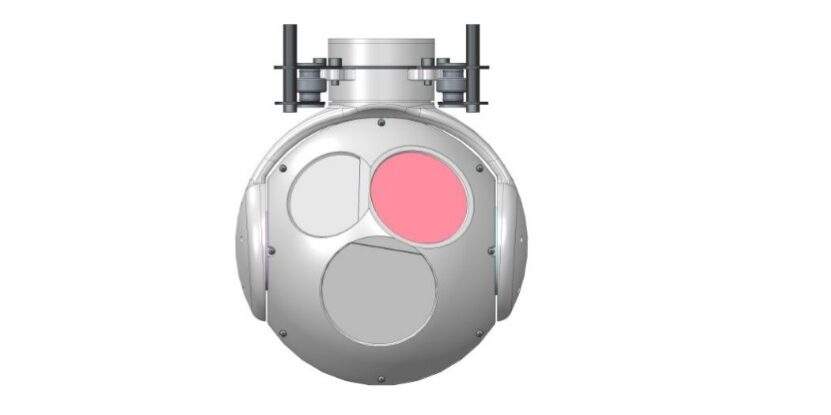
Main Features:
- a) It has the functions of automatic identification and automatic tracking of typical targets;
- b) It has the functions of self-test and fault reporting;
- c) It has the ability to detect long-wave uncooled infrared and visible light bands, and can output infrared images and visible light images;
- d) It has the function of laser ranging;
- e) Visible light has the functions of optical zoom, auto focus, manual focus, fog penetration and low illumination;
- f) Infrared has 1.0~4.0 times electronic magnification and 6 kinds of pseudo-color switching functions;
- g) It has the ability to move in two degrees of freedom in azimuth and pitch;
- h) It has multiple working modes such as heading lock/manual search/follow-up/attitude stabilization/tracking;
- i) It has the ability to isolate carrier disturbance and stabilize the visual axis;
- j) It has the ability to lock/unlock targets function, and after locking the target, the pod outputs an image with a tracking frame;
- k) It has the function of automatic target tracking, can automatically track the target, and has the ability to resist natural interference;
- l) It has a memory tracking function, and the target can be captured again in a short time after being lost for a short time;
- m) It has the function of adjusting the size of the wave gate;
- n) It has the function of switching tracking points;
- o) It has the ability to calculate the target coordinates based on laser ranging, drone position and attitude information;
- p) It can communicate with the control station in two directions through the serial port/100M network (UDP), and can output information such as system working status, camera working status, optical axis position, etc.;
- q) It has HD-SDI and 100M network video interface (RTSP protocol);
- r) It has the function of taking pictures and recording videos;
- S) Detect distance :5KM